Showing posts with label Lincoln. Show all posts

Saturday, 26 August 2017

30 Days Wild day 25- Ladybird hatching


We have a big cherry tree in our back garden which, at the moment, is covered in rapidly encroaching ivy. This, in turn, is absolutely full of ladybird larvae and pupae. I've got a nasty feeling they're harlequin ladybirds rather than a native species, but it's still a fantastic opportunity to watch their life cycle. 

30 Days Wild day 24- Bees

It feels like a very long time since I published the last post for 30 days wild. The past few months have been much busier than I expected, and unfortunately updating this blog has had to take a back seat. But now I'm back! Over the next few days I'll be posting the rest of my 30 Days Wild blogs, and then I'll move on to what I've been getting up to since.

* * *

A screenshot of the 30 Days Wild app, showing a picture of a bumblebee on a flower and the text "Follow a bumblebee. You'll need your eyes & ears to keep up!"

The university term finished on Friday, so today saw me heading back home to Lincoln. This meant I didn't have a huge amount of time for acts of wildness, so I turned to the 30 Days Wild app for inspiration. Its suggestion: 'Follow a bumblebee.' This seemed fitting- in the summer, the garden at home is always full of bees and other pollinators. This is particularly striking after spending term time in York, where the terraced streets around my house make bees and butterflies rare. 

A bumblebee on an Escallonia flower

At home, there's an Escallonia sp. shrub at the very edge of the drive. We're not sure which species it is, because it's been there so long no one can remember. I suspect it's an Escallonia rubra of some sort, which the RHS includes in their 'perfect for pollinators' list. Whatever it is, the bees love it, and the sound of their buzzing greets you as soon as you get out of the car.

Wednesday, 14 June 2017

30 Days Wild day 11- Bird ring

I was in town again today, wandering round the Cathedral and looking around some open gardens when I spotted something moving on the ground. Over the past couple of years, I've been training myself to notice movement. This is a really useful skill for spotting wildlife, although perhaps not quite so good for holding conversations.

The movement was a bird's leg, complete with BTO ring, rolling in the breeze. The RSPB volunteers looking at the peregrines were just around the corner, so I took it over to them. The leg was scaly and surprisingly long- it looked like it might have belonged to some sort of wader or waterbird. Unfortunately the foot was very damaged, which made identifying it tricky. I'm looking forward to hearing what it was and where it was ringed!


Saturday, 10 June 2017

30 Days Wild day 9- Blackbird bubs

The blackbirds nesting in the back garden fledged early this morning. The main clue to this was the fact that the mother started alarm calling around 8am and hasn't stopped yet. The actual bub was very hard to spot, beautifully camouflaged with its speckled feathers amongst the shadows. My mum eventually spotted it deep in a tamarisk in the garden. Whether it's the only chick to successfully fledge or its siblings are hidden somewhere else is hard to tell.

Blackbird chick in the tamarisk shrub

The mother has been doing circuits all morning, foraging in a small area of garden, alarm calling all the while, only going quiet when just about to feed the bub. She's taken it mealworms, caterpillars and unripe cherries off the tree, but the favourite seems to be the suet pellets we've put out in a birdfeeder nearby.

Mother blackbird with mealworms in her beak

By waiting very quietly and getting just the right angle we were even able to see her feeding the chick. She had moved it right into the centre of the shrub, sheltered from the worst of the weather. It stayed there for the rest of the day; hunkered down. Obviously it was somewhere it felt safe.

Mother blackbird feeding the chick

Wednesday, 31 May 2017

Nightingale

I'm coming to the end of my third year at university, and the project reports, exams and essays mean that I don't have as much time to get outside into nature (or to blog!) as I would like. But a few weeks ago I took some time off to visit Whisby Nature Park and experienced something extraordinary. I heard a nightingale sing. 

Whisby has become famous for nightingales, with singing males every year and a relatively stable population. Despite this, I'd never knowingly heard one before. I don't think reading or talking about them prepares you for the real thing.

We were walking past hedgerows thick with hawthorn just coming into blossom and blackthorn fading out of blossom, when a noise stopped us. There was an overwhelming sense of a small bird being disproportionately loud, like catching sight of a singing wren and being slightly stunned that such a tiny bird can make so much noise.

Common nightingale Luscinia megarhynchos singing on a branch

There's a tonality to nightingale song which isn't quite like anything else. There's something almost electronic in those rapid runs of notes, but very much analog instead of digital. It sounds like a blackbird in full midsummer song crossed with a stuck record playing 1970s prog.

I didn't see the nightingale (I'm told you rarely ever do). Not properly, at least. But I caught a tantalising glimpse of something in the hedgerow, about head height. Small and brown, flitting from branch to branch. It might have just been a robin. But the song was unmistakable.

Nightingale from The RSPB on Vimeo.

Monday, 5 September 2016

Lincoln Cathedral Peregrines

As you'll know if you followed my #30DaysWild blogs, as of June 2016 wasn't proving to be a very good year for seeing peregrine falcons. I had not one but two unsuccessful attempts at spotting the pair which call York Minster their home. But all that changed back in July, when I caught up with the Lincoln Cathedral peregrines.

Peregrine falcon in flight

This is the 10th year that the peregrines have nested on the cathedral, and it's been another successful season. Three chicks have been successfully fledged, taking the total raised since they first nested up to 27. All three chicks and both parents were being regularly seen through the summer; I was thrilled when I was able to see two of them. The first which I spotted was a single bird sat on the nesting platform on the side of a tower. This was exciting enough after so many failed attempts to see them in York. But it was when I walked around the corner to Minster Green that the show really began.
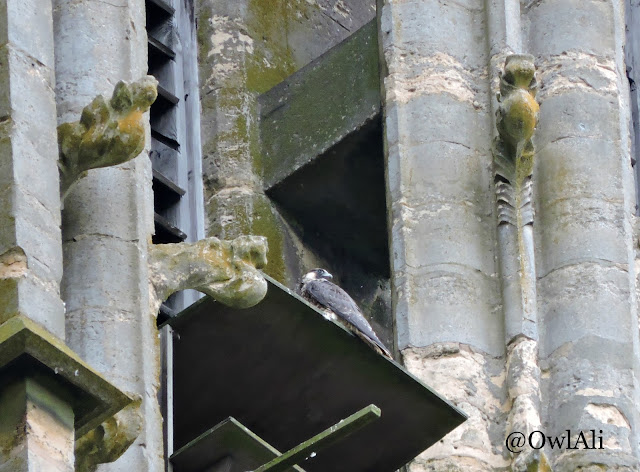
Peregrine falcon on Lincoln Cathedral nest platform

I was trying to find a better angle to photograph the first peregrine on its perch when the second appeared overhead, almost too fast to process. We were still debating if it was definitely a peregrine when it appeared again, flying slower this time and unmistakable. It was a juvenile, and appeared to be having some difficulties with the stronger than normal winds that day. Trying to land on a weather vane on top of one of the towers, it circled round and round, passing closer each time but never quite close enough. I could see it reaching out with talons extended, but overshooting and being carried past by the wind. On one pass, it even managed to catch hold before a bigger gust blew it off again, as if in slow motion. 


The juvenile peregrine wasn't just practising its aerial manoeuvring; it was also keeping a close eye on the local pigeons. Whenever one broke cover within sight, the peregrine drew itself upright on it's perch, watching intensely. And if there was one which might be within catching distance it was off, swerving round the architecture or diving from a tower. It flew in high speed chases around the Chapter House, as the pigeons darted from ledge to ledge so they were airborne for the shortest time possible, I once read that urban peregrines will  fly out to fields to hunt, rather than predating the resident pigeons, but it seems no one had told this peregrine. 

I didn't see it catch any pigeons, but it was a privilege to watch the fastest animal on the planet make the attempt. I'm so glad I didn't give up trying to see a peregrine falcon this summer.  

Have you had a fantastic peregrine encounter this summer? I'd love to hear from you!