Showing posts with label York. Show all posts

Thursday, 29 June 2017

30 Days Wild day 23- Bullfinch

I walked to a friend's house for lunch today, and part of the route took me along the side of a supermarket car park, lined with small conifers. I was walking along, not really paying much attention, when I heard bird noises coming from one of the trees. It was a pair of bullfinches. I don't often see them- despite the bright colours of the male they are relatively quiet and unobtrusive. They are also in decline, with the UK population 36% lower than it was in 1967. So seeing these charasmatic little birds was a treat, and demonstrated that even the unlikeliest places can provide habitat for wildlife.

Adult male bullfinch
By © Francis C. Franklin / CC-BY-SA-3.0, CC BY-SA 3.0, Link

30 Days Wild day 22- Elderflower

I didn't have much time today for random acts of wildness. Various jobs which needed doing on campus and at the house before the end of term kept me busy for most of the day. But the walk between campus and my house in York is really quite special, when I stop and take notice of it.

Path running between trees, lined with cow parsley

In spring, the path is lined with flowering blackthorn and hawthorn, with garlic mustard growing tall beneath them. But in June, the elderflower and cowparsley steal the show. The air smells green and growing from nettle flowers, but if you get close enough the elderflowers cut through it all with their sweet, floral scent. The flowers are incredibly beautiful too, when you look at them closely. The 5 white petals and stamen covered in pollen make them look like tiny stars.

Close up of elderflower. The flowers look like white stars, with yellow stamen covered in pollen.


30 Days Wild day 21

The heat had died down a little today, though it was still warm enough to sit outside into the evening. Clouds had started to appear, and although they made the blue of the sky less striking, once dusk began to come down they glowed golden. Swallows, swifts and house martins darted above the lake. Every so often they swooped down, almost brushing the surface to catch insects newly emerging.


Wednesday, 28 June 2017

30 Days Wild day 18- Heslington East pt. 2

It's the York Festival of Ideas at the moment, and today I went to a talk on de-extinction. It's an interesting concept and one which I'm somewhat conflicted about, but that's not what my random act of wildness for the day was. The talk took me back over to Heslington East, this time during the full heat of the day. It felt very different- sun bleached and heat-hazed, with the wildflowers humming with insects. There was no sign on the hobby returning, but I watched a kestrel hunting. It sat on the top of a lamppost watching the ground before taking off, hovering for a second and then dropping down onto prey below.

A kestrel sat on the top of a lamp post

At the side of the lake, the air was full of damselflies, thin streaks of electric blue and green. Brown  butterflies which I didn't recognise were darting between flowers. The sound of skylarks was everywhere. I stayed as long as I could, until the heat and an orchestra rehearsal which I couldn't miss drove me home. But even as I walked back towards the city, some of the quiet stayed with me.

Looking through wildflowers (knapweed and oxeye daisy) to the lake on Heslington East

Tuesday, 27 June 2017

30 Days Wild day 17- City Parks

I spent today doing what seems to be the instinctive response to warm weather in cities, and headed for the park. I went to Museum Gardens and found a patch of dappled shade, where I sat with my book, a smoothie and a pack of reduced strawberries. 

The ruins of St. Mary's Abbey in Museum Gardens

Museum Gardens was absolutely full of people, on benches or lying on the grass, picnicking and just soaking up the sunshine. It's a very domestic sort of wild- worlds away from my evening on Heslington East, or the moors and islands described so lyrically in the book I'm reading. But the birds are singing and the breeze is playing in the trees. And there's a camaraderie in being part of a group of people all doing nothing much together, sharing a space and an afternoon in the sunshine. It's important to remember that you don't have to be the only person for miles around to enjoy spending time in nature. 

30 Days Wild day 16

Today, I went back to one of my favourite places on campus. There's a bench near the biology department, beneath two weeping willows at the side of the lake. Sitting there feels like sitting within the tree, with its limbs drooping down on all sides, surrounding me.  There are coots nesting nearby-  the begging of their chicks was the loudest thing I could hear. The geese on the other side of the lake were honking quietly. The hustle and bustle of the main areas of campus felt a very long way away.


Sunday, 25 June 2017

30 Days Wild day 15- Magpies and coot chicks

I had another day on campus today, and the weather was glorious. It felt like it would be a shame to miss out on the chance of another picnic (I think a theme for this year's 30 Days Wild is starting to develop). This time, I sat on the benches between the biology department and the lake. I was joined by a magpie, glorious in its iridescence. It bounced between the benches as though looking for leftover food, although with little success. After a while it moved back towards the lake and its mate. I wonder if they are nesting nearby- I've never found any sign of a nest, but I see the two of them there so often I think they must be close.

A magpie alongside the benches

The chicks from the coot nest on the fallen tree down at the side of biology are large now. They're almost the same size as their parents, although their feathers are still downy. This doesn't stop them begging incessantly for food- a soft, high peeping which feels like a constant by the lake at this time of year. 

Thursday, 15 June 2017

30 Days Wild day 14- Dean's Yard

This evening I went to see some of my friends perform in the University Symphony Orchestra and Choir concert at York Minster. It gave me a brilliant excuse to do something I've wanted to do for ages- have a picnic in the Dean's Park.

The front of York Minster

Sadly, I didn't see the peregrines. But I sat in the sunshine surrounded by bickering blackbirds and pigeons and squirrels. It was lovely. It's so easy to forget how lucky I am to be studying in York. Things like this remind me that I need to make the most of it. 

York Minster from Dean's Park

Wednesday, 14 June 2017

30 Days Wild day 13- Heslington East

I spent the day on campus today, and while as normal there were plenty of ducks and geese, it didn't feel like I'd done anything in particular to qualify for 30 Days Wild. So, in the evening, a friend took me over to the Heslington East campus. I don't think I've been there since half way through my second year, as everything I do is on the main campus. I've been missing out.


It was beautiful. We arrived around 8.30; the light was a pre-dusk gold and the whisps of cloud looked like watercolours. It's a new campus, and there has been some really impressive habitat creation. There are a series of lakes, complete with natural, reed bound edges. Wildflowers have been sown too; whole swathes of the ground were covered with oxeye daisies, yellow rattle and brilliant blue cornflowers. There were, as on the main campus, lots of waterfowl- ducks and geese galore, with seagulls swooping overhead. But it became immediately apparent that it's much quieter and much wilder than Heslington West. As we got off the bus and headed towards one of the lakes there was a high, piping call, striking amonst the quiet duck noises. An oystercatcher flew overhead. A pair of common terns were nesting on a platform in the middle of the lake. As dusk drew in, a distinctive white shape glided along a line of mature trees before floating over to the meadow on the far side of the lake. It made 3 dives in quick succession before settling down on to a fence post, then it was airborne again. It made one final, successful dive then floated back down along the hedgerow to a tall tree and, presumably, its nest.

This is not the best barn owl photo which has ever been taken. One for #wildphotofails, perhaps? 
We walked further, up to the north, past grassy banks full of improbably tame rabbits, before heading back amongst the buildings. The oystercatchers were back, at least two pairs flying overhead. After a little patience it became apparent why. They were nesting on the flat roods of one of the buildings, safely out of reach of any terrestrial predators. The noise they made was unearthly.


There was one final treat as we headed back towards the bus stop. We were looking out onto the lake, watching the gulls dive and the mayflies dance., when a shape appeared. It was a bird of prey; at first I thought it was a kestrel.  But its wings were too long and its flight was very different- swooping and diving over the water, taking impossibly tight corners at the height of its circuit before diving back down to skim above the surface. It was a hobby hunting insects, and the first I've ever seen in this country. We stood and watched it until the light was too dim to properly make out its movements. It was a stunning moment.


Friday, 9 June 2017

30 Days Wild day 5- Swallows in the rain

 It was a rainy day in York today, one of those days which, when I was little, I'd have referred to as "nice weather for ducks." The ducks I saw on campus did not seem to agree. I had to go round to a friends in the morning, so I decided to get out my waterproof and walk rather than catching the bus. I saw barely anyone as I walked- everyone seemed to be sheltering. The weather didn't seem to be stopping the wildlife though. The hedgerows and trees around the paths were still full of movement and the sounds of singing birds. And the rain really didn't seem to be stopping the hirundines. There were swallows and house martins swooping over the lake on campus, catching insects. That's nothing unusual, but they were directly over the bridge across the lake. Walking over it felt almost like being high in the air, with birds swirling alongside me and just above my head. It was well worth getting rained on for.

30 Days Wild day 4- Geese

I'd arranged to meet a friend on campus around mid afternoon, and arrived a little early, so I sat on a bench near the music department to wait.  I was minding my own business when some geese approached, goslings in tow.


The goslings on campus seem larger than they did this time last year- most have already started to get their adult wing feathers, although they're still awkward and gangly and a little way from full grown. Whether they actually started breeding earlier or not is hard to tell, of course, as it's easy to not see goslings at all until they're a few weeks old. There are certainly still some smaller goslings around.


Another family started to approach too, the goslings still fluffy and the parents far more protective and wary. The goslings seemed completely unconcerned by my presence. It never fails to amaze me just how habituated the wildlife on campus can be.                                                                                                                            

Wednesday, 6 July 2016

30 Days Wild day 19- Peregrines again


After my last unsuccessful attempt to see the peregrines on York Minster, I decided to have another go. Unfortunately, my luck was no better this time around. Yet again, there were lots of pigeons but no birds of prey that I could see.


However, my day wasn't entirely bereft of peregrine falcons. Their frequent nesting in cities means that there are lots of nests which are highly monitored, and quite a few with nest cams which you can watch online. I went into the Hawk and Owl Trust website to see what I could find. 

Sadly, both the Norwich and Bath peregrine falcon nests had already fledged by the 19th. However, there was lots of footage from the 2016 season, which you can see here and here. It was lovely to be able to see such intimate footage of birds which are normally only seen high above you. However, if you do decide to look at the Hawk and Owl Trust nest cam footage, I should warn you that the Norwich peregrines didn't get a happy ending to the season. 

30 Days Wild day 18- Treecreepers


Originally, I came onto campus today to photograph the grebes before the summer, but I very quickly got distracted. Movements from the trees nearest the bench I was sat on caught my attention, and I found myself next to a pair of treecreepers, accompanied by their begging fledgling. 


They worked their ways up the trees, the fledgling leading and the parents following up the main trunk, occassionally flitting away into the outer branches or a neighbouring tree to find more of their insect or spider prey. They move distinctively in a fast sort of creeping motion, climbing up the rough bark rather than hopping from branch to branch the way other birds of similar size would. 


Treecreepers are one of my favourite birds. They're relatively common and widespread, but so secretive and quick that they are tricky to see, never mind photograph. They're one of those birds which are a real reward for the patience it takes to get close to them. This was the first time I've ever managed to get photographs of a treecreeper. They aren't perfect, of course, but I'm pleased with the results all the same.

30 Days Wild day 17

It's always slightly surreal to spend time on campus at this time of year. Today was officially the last day of term, and while there were still a few students, either living in halls or like me doing the last few admin tasks before summer, it was strangely quiet.


The lack of people seems to make the wildlife on campus even more visible. This year's greylag goslings are mostly grown now, almost indistinguishable from the adults. Where before there would be a few adults surrounded by creches of goslings, now they move in huge groups, the adults and juveniles intermingling. The paths seem to be entirely strewn with feathers. It's difficult to tell from first glance if they belonged to moulting geese or very unfortunate pigeons. I suspect it's a combination of the two. 

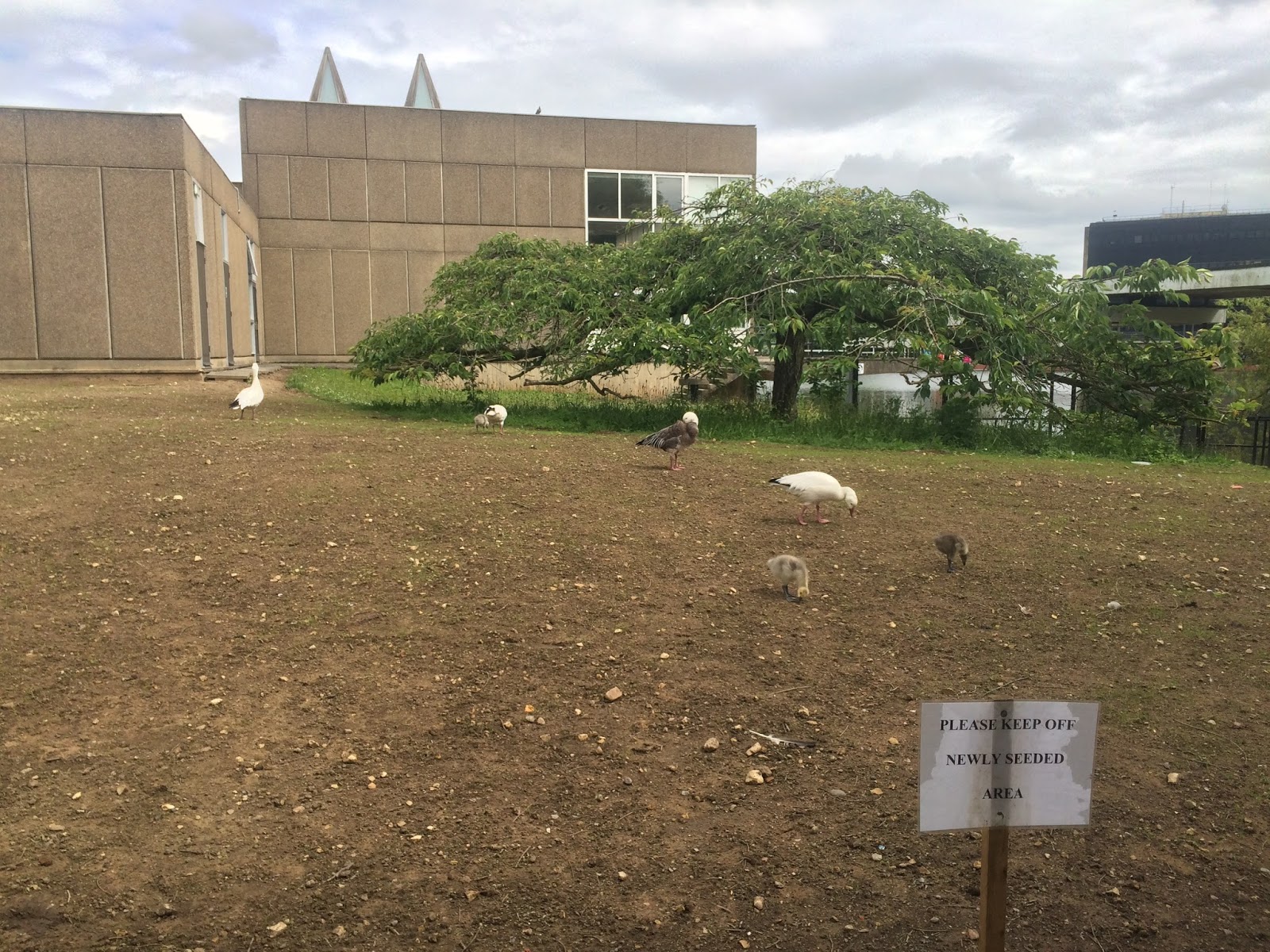
The snow geese always seem to be the last to breed on campus. I caught up with a group today, several adults with their young in a big group, making the most of newly seeded areas. The irony of the "please keep off" signs amused me more than it probably ought.


The slightly surreal feeling of being on a very quiet campus was only heightened by the weather. It's been overcast all day, but this afternoon it began to take on that strange, oppressive air and almost sepia light of oncoming rain. The wind picked up, and blew feathers across the path. If it wasn't for all of the academics walking past, coffee in takeaway cups, I could have been the only person here.

Today was also the celebration of the  70th Anniversary of the Yorkshire Wildlife Trust, with the main event, an evening with David Attenborough, taking place on campus in the evening. Sadly I wasn't able to get tickets, but a live stream meant that I was still able to watch! The talk was also recorded, and can be watched here.

Sir David spoke several times about the importance of engaging people, especially children, with nature. If people aren't interesting in nature, they simply won't care enough to protect it. And I think children are definitely the best group to start with. I've read so many things from conservationists or naturalists despairing about the fact that 'children nowadays' spend all of their time in front of computers instead of in nature. But that doesn't mean we should give up hope of engaging the next generation of wildlife lovers. We just have to be a little more creative. And if you've ever seen a whole class full of childrens' eyes light up at the prospect of holding a giant African land snail or stick insect on a school trip, you'll know that it is far too soon to give up hope. 

30 Days Wild day 16- Askham Bog

Back at the end of May, before 30 Days Wild had even got started, I got a tweet from Yorkshire Wildlife Trust recommending a visit to Askham Bog nature reserve on the outskirts of York. It wasn't somewhere I knew anything about before, but on seeing that you could get there by bus from town, I decided it was somewhere I would have to visit!
So on the 16th me and my housemate Derek caught the bus and went off to explore. The journey was an adventure in itself; a misunderstanding about the bus route meant we spent 20 minutes trying to escape from a supermarket car park, and our walk was about twice as long as it should have been. But we got to Askham Bog in the end, and it was definitely worth the journey!


It's a brilliant nature reserve; a patchwork of woodland, meadow and bog, with a large, circular path around it. The signs and information boards invite you to go off the raised wooden walkways in certain places, which I really liked. Unfortunately the rain of the previous few days meant that these tracks were just too muddy for us to navigate in the shoes we were wearing. Hopefully I'll be able to go back when it's a little drier to properly explore.


Even restricted to the boardwalks, there were huge amounts of wildlife. Every 50 metres there would be a squirrel on the path. Several times they were so unconcerned by us being there that, walking slowly, we were able to follow them down the path for 5 minutes at a time.


The air was full of bird song. I've spent the past couple of years trying to learn bird calls, in a fairly haphazard way, However, on my Tanzania field trip over Easter, I saw just how useful a tool knowing bird song can be, so I decided to properly pay some attention to it. There was a bird calling from a stand of willow just off the path, which sounded like a chiffchaff. Comparing it to the recording on the RSPB website, we found out that we'd been right, and it had indeed been a chiffchaff. It was so hidden by the vegetation, we'd never have been able to see it well enough to identify it otherwise.

A little bit further along the path, we came to a wetter area of meadow, with a channel at the far end full of reads. And perched within it was a bird. It was small and nondescript, a proper 'little brown job'. But it was beautiful in a delicate sort of way, and it was singing constantly and loudly. I hadn't seen anything like it before. Something in the back of my mind about the strange, almost mechanical song said warbler, so again, we went onto the RSPB website in search of something which looked, and more importantly sounded, the same. We found it in the end- a sedge warbler.


There's also a pond at Askham Bog, which was full of damselflies when we visited. The board walk goes right up to the edge, and it was great to be able to get such a close look! Lots of the pairs were in tandem, clasped together and darting the the water surface to lay eggs or resting on leaves of water plants. Single males danced around the pairs, looking as though they were trying to intercept the females.


A little further along, we startled a great tit in the undergrowth by the path. It flew up into a big oak tree, obscured by leaves and branches. We waited to see if it would move into a position where we could get photographs. This didn't happen, but it did lead us to a fledgling, obviously one of its own offspring, which was following the adult through the branches. It begged for food continuously,  calling and fluttering its wings, hopping from branch to branch.

We had our lunch on a bench looking out over an area of meadow. It was incredibly peaceful, with birdsong and the humming of insects all but obscuring the noise of the nearby main road. Suddenly, an adult roe deer appeared. She bounded across the meadow as if in slow motion, no more than 50 metres away from us. We were both too mesmerised to react. After she'd gone, we turned to each other, mouthed "did that really just happen?" and burst into incredulous laughter. It was entirely surreal.

One of the things I really enjoyed about visiting Askham Bog was how friendly and helpful so many of the other people we saw there were. People were asking what we had seen, and telling us their sightings in return. A passing couple told us where to look for bee orchids on the walk back to the bus. One man, who we'd been following around the circular paths for a little while, occasionally nodding in greeting, actually came to fetch us when he found a deer a little bit further ahead, right next to the path. It was another female roe deer, immersed in meadow grasses up to her belly and, to all appearances, supremely unconcerned to find three humans wielding cameras in her patch. It's the closest I've ever got to a wild deer, and was an incredibly special moment.


We stayed at Askham Bog until the weather began to turn in the late afternoon. The boardwalk may have been a relatively short circular route, but we did two or three laps and saw something new every time. I was hugely impressed by this hidden gem just outside York, and will definitely be visiting again now I know how to get there!


We even managed to find the bee orchids on our way home. The closest bus stop to the nature reserve is the park and ride at Askham Bar, and to get there we had to walk along the side of a busy road with wide verges. They were full of rabbits and wildflowers.
If you want to visit Askham Bog (and you really should, because it's fantastic), you can find more information, including directions, here. If you'll be travelling by bus from the city, the number 3 to Askham Bar is probably the best route, although please check this is still right before you travel. We found GPS on smartphones very helpful to find our way from the park and ride to the nature reserve. And if you're planning on going off the path, wellies will be very useful!

Saturday, 2 July 2016

30 Days Wild day 15- Tansy beetles

After reading up on tansy beetles for my day 2 blog, I decided to go in search for them. The tansy bed is tucked away in museum gardens, down in the south west if memory serves correctly. It's not a part of the gardens that I often go into, so I'm not surprised I'd never found them before!


The thing that really took me by surprise was their size. At a centimetre or so long, they're far larger than I expected. They're also incredibly beautiful. Bright emerald green, they were iridescent in the sunshine, glowing yellow and bronze.


Tansy beetles are, as I said in my previous post, endangered in the UK. Reliant on riverside tansy plants and unable to fly other than when newly emerged, they are vulnerable to habitat loss and seasonal flooding. The beetles in Museum Gardens were captive bred and released as part of buglife's conservation efforts.


It's easy to think of urban wildlife as dull, all pigeons and feral Buddleja. But that simply isn't true. One of the rarest species in Yorkshire is easily seen in the middle of York if you go at the right time of year. In my opinion, that's definitely something to celebrate!

Wednesday, 22 June 2016

30 Days Wild day 8- Wildflower identification

Wildflowers are one of many things which I know far less about than I'd like to. So, I decided that for today's #30DaysWild I would take inspiration from the 30 Days Wild website and app, and try to identify a wildflower species which I've been wondering about for weeks.


The walk between my house and university takes me past a shady area full of hawthornes and crab apple trees, and since mid spring it has been full of what I classed, in a vague sort of way, as 'something a bit like honesty (Lunaria annua).' 


I didn't really pay it much attention until it started flowering, when it became apparent it wasn't honesty at all. The flowers were far smaller, and left long seed heads, more like oil seed rape than the distinctive round disks of honesty. So I took some photos of the plants as I walked past them on my way back from university for a more thorough investigation.

The Botanical Society of Britain & Ireland has some fantastic online resources, including a brilliant identification key which I used for this. There are a series of questions on everything from where a plant was seen to if its leaves have stalks (or petioles) joining them to the stem. It them brings up a list of possible results, starting with the most common.

It turns out my mystery wildflower is Alliaria petiolata, also known as garlic mustard. 


  I really love the fact that so many resources like this are available online. While I'll always love bird books and old fashioned identification keys, tools like this make finding out about the natural world so accessible. At a time when there are serious problems engaging children with nature, that has to be a good thing.