Showing posts with label photography. Show all posts

Sunday, 27 August 2017

30 Days Wild day 26- Wildlife on holiday


I spent the end of June on holiday with my parents in Norfolk. This was mainly to give us all a bit of a break before the annual village carnival which my dad organises. However, we happened to be staying in a forest, which was great for finishing off 30 Days Wild (although awful for getting any blog posts written because there were always more exciting things to be done).

Before we'd even finished unloading the car, I'd spotted the treecreeper and the nuthatch. The rest followed not long afterwards, either seen from the deck of our cabin or on a quick walk through the forest. Every rustle of the leaves was something new to look at, and it didn't take long to tune our eyes in and start picking out movement amongst the trees.

A fledgling blue tit in a nest of branches

Saturday, 10 June 2017

30 Days Wild day 9- Blackbird bubs

The blackbirds nesting in the back garden fledged early this morning. The main clue to this was the fact that the mother started alarm calling around 8am and hasn't stopped yet. The actual bub was very hard to spot, beautifully camouflaged with its speckled feathers amongst the shadows. My mum eventually spotted it deep in a tamarisk in the garden. Whether it's the only chick to successfully fledge or its siblings are hidden somewhere else is hard to tell.

Blackbird chick in the tamarisk shrub

The mother has been doing circuits all morning, foraging in a small area of garden, alarm calling all the while, only going quiet when just about to feed the bub. She's taken it mealworms, caterpillars and unripe cherries off the tree, but the favourite seems to be the suet pellets we've put out in a birdfeeder nearby.

Mother blackbird with mealworms in her beak

By waiting very quietly and getting just the right angle we were even able to see her feeding the chick. She had moved it right into the centre of the shrub, sheltered from the worst of the weather. It stayed there for the rest of the day; hunkered down. Obviously it was somewhere it felt safe.

Mother blackbird feeding the chick

Wednesday, 6 July 2016

30 Days Wild day 18- Treecreepers


Originally, I came onto campus today to photograph the grebes before the summer, but I very quickly got distracted. Movements from the trees nearest the bench I was sat on caught my attention, and I found myself next to a pair of treecreepers, accompanied by their begging fledgling. 


They worked their ways up the trees, the fledgling leading and the parents following up the main trunk, occassionally flitting away into the outer branches or a neighbouring tree to find more of their insect or spider prey. They move distinctively in a fast sort of creeping motion, climbing up the rough bark rather than hopping from branch to branch the way other birds of similar size would. 


Treecreepers are one of my favourite birds. They're relatively common and widespread, but so secretive and quick that they are tricky to see, never mind photograph. They're one of those birds which are a real reward for the patience it takes to get close to them. This was the first time I've ever managed to get photographs of a treecreeper. They aren't perfect, of course, but I'm pleased with the results all the same.

Saturday, 31 October 2015

Autumn at Fountains Abbey

So, autumn is here again. The leaves are changing colour, the nights are drawing in and York is perpetually foggy again. I had an incredibly busy summer, so I'll be writing about what I got up to over the break soon. But first, something a little more seasonal.


My favourite season is almost always the one I'm currently in, and this autumn is no exception. I love the sense of transition that autumn has; somewhere between the lushness of late summer and the starkness of winter, every day is different as the seasons change and the plants and wildlife react to it. Last weekend I went to Fountains Abbey with my family to make the most of a patch of good weather. It's a beautiful place whatever the time of year, but autumnal sunshine really showed it at its best.


The abbey is incredible and well worth a visit in its own right. A Cistercian monastery from the 12th century up to the Dissolution of the Monasteries in the 16th century, it is one of the most impressive ruins I've seen in the UK. There is something incredibly atmospheric about seeing the tower, almost intact, rising from the ruined cloisters. When we looked around the abbey, the light was beginning to fade as the mist drew in, and it became one of those rare places where even the air feels old.


The reason we didn't get to the abbey itself until it was nearing dusk was because of the other brilliant thing about Fountains- Studley Royal Water Garden. The remains of the 18th century grounds of a stately home, they are complete with wooded slopes, reflective ponds and, of course, follies. With the trees in their autumn finery, the opportunity of getting some photographs of reflections in the ponds was too good to miss! When we visited most trees still had their leaves, but the yellows, oranges and russets were really starting to shine through the green. Then, as the fog drew in, all the colours became more ghostly, until you could barely make out the abbey in the middle distance.  


Until the 29th November, the grounds at Studley Royal are playing host to 'folly!' This series of art installations is themed around "visual trickery and untold histories" and incorporates some of the many follies within the parkland. My personal favourites were both by Gary McCann. 'Lost property' is a giant magpie nest filling a Grecian temple, surrounded by 'stolen' objects from visitors to the site, and 'Scavenger' is the huge, beautiful statue in the photo above. I love crows, and this statue really seemed to capture the intelligence and awareness of these fascinating birds. I also loved the way that they brought a sense of wildness into such a man-made space; a timely reminder that nowhere is too human to let nature in.


Fountains Abbey and Studley Royal form part of the same site, owned by the National Trust. They are a few miles away from Ripon, and well worth a visit if you're anywhere near Yorkshire this time of year.

Saturday, 4 July 2015

30 Days Wild- Week 2

Time has run away with me and I've been racing to try to keep up. If you didn't see my daily #30DaysWild updates on twitter, here's what I got up to in week 2..,

Monday 8th June
I didn't have a huge amount of free time on Monday, so went to have a closer look at somewhere I spotted earlier in the week. May I present... The prettiest roundabout I've ever seen...


 This is about 5 minutes away from where I'm living and has been full of wildflowers for about a fortnight. It is also, not unsurprisingly, a real haven for insects. It's such a good idea to use what could otherwise be a grass monoculture to provide a wildlife resource. It's also a great way to make nature accessible, to pedestrians and road users alike, and the splash of colour certainly brightened up my day!


Tuesday 9th June

Tuesday was another hectic day, with a presentation in the morning, a choir concert at lunchtime and the summer ball in the evening. I wasn't sure how I'd manage to fit in a random act of wildness, but luckily everything worked out well. There was an absolutely stunning sunset, and walking around the lake to get to the buses gave me a real chance to enjoy it.


The light is always beautiful on the lake at sunset, but the sky somewhere between blue and purple along with the golden reflections on the water really struck me. And the yellow flag irises which surround lots of the lake almost seemed to glow in the dusk.


Wednesday 10th June

Black and white photography isn't something I've really done much of before (I enjoy bright colurs far too much usually) but I was inspired to after my phone camera, which was all I had with me at the time, couldn't handle the colour of these copper beech leaves.


I'm so pleased with how they worked out. Somehow it seemed to capture the way the light fell in patterns through the branches than my first lot of colour images. I love the way the leaves shadow and overlap each other.


They're not the best photos I've ever taken but it's reminded me that black and white photography is actually doable. While I'm going to keep to colour photos most of the time, it's definitely something I'll be coming back to!


Thursday 11th June

I went for a walk by the lake to see if I could catch up with the great crested grebes again. On the way I got distracted by these moorhen chicks. I think it might be the same family I saw last week as they were in the same place and looked about the right size, although obviously I could be wrong. They are certainly much more independent than the chicks I saw last week, calmly standing on the banks while the parents were a little way away, foraging. I loved the way they were stood in the beam of sunlight and how it made their down look almost halo-like.


I also managed to catch up with the grebes. This isn't the family I've been following (which had either two or three chicks, more on that in another post) but they also live on the university lake. This chick is a week or so younger (I'm not sure exactly when they hatched) and so was still being fed by a parent. It was almost comical to watch; the chick would chase the parent, squeaking incessantly and begging for food. The adult waited until the chick had almost caught up and then dived. The chick was left on the surface, looking around with a general air of confusion, until the adult resurfaced. Then the chick would charge towards it, squeaking, and the whole thing would begin again. Every so often, the adult would feed the chick, which made no effort to dive itself. I think it will still be a little while before this one is independent.


I sat on a bench at the edge of the lake for a little while, trying to photograph the grebes and keep an eye on the ducks which were trying to bite my toes. I'd half noticed a seagull circling around my part of the lake, but hadn't paid it much attention. It wasn't until it started hovering, almost kestrel like, then dived like a bird of prey I realised it wasn't a herring gull. It was actually an Arctic tern, incredibly fast, and so manoeuvrable I thought I'd lost track of it several times before realising it was now flying in the opposite direction. It certainly lived up to the name: 'sea swallow.' Unfortunately because it was so fast my photos were pretty bad, and this is the best one I managed to get. One for #wildphotofails perhaps, but I enjoyed seeing it so much I really don't mind.


Friday 12th June

As I was walking back from visiting York I saw this plant. It was covered with what looked like cobweb, and when I looked closer I could see caterpillars and what looked like pupae. It's something that I've read about several times, but as far as I can remember never seen, certainly not to this extent. I did some googling after I got back to my flat, and I think they're either ermine moth caterpillars or tent caterpillars. However, like most insect things there are so many possibilities that I have absolutely no idea how to get any closer to identifying them. So, if you happen to know caterpillars, I'd love to hear your ideas! Sadly, this is the best photo I was able to get with my phone.


Saturday 13th June

Yay, more insects today! I was in York again and so decided to go to museum gardens, one of my favourite spots in the city. It's absolutely lovely when the weather is good, always full of families and people having picnics, but it has a lovely atmosphere even when it's overcast and grey. Thankfully I didn't actually get rained on, and so was able to put some time into seeing whether my phone can handle close up photos. I found a handy oak tree which was small enough for me to reach the leaves, and tried to see what I could find.


It turned out to be mostly covered in aphids. While not the most exciting thing that you get on oak trees, aphids are far more interesting than they appear. They're a brilliant example of a symbiosis, producing honeydew which is eaten by ants that in turn guard the aphids from predators. Some also have a symbiotic relationship with the bacteria Buchnera aphidicola, which produces essential molecules which the aphids cannot synthesise or obtain from their food. 


Their reproductive strategies also make aphids worth a second glance. Many species use a combination of sexual and asexual (or clonal) reproduction in order to achieve the rapid population growth which lets them exploit favourable conditions. Some even have telescoping generations, where an adult female has a daughter developing in her reproductive system which is herself already parthenogenitically producing her own daughters. So a single adult aphid can actually represent three generations. Enough to make the humble aphid worthy of a little more admiration in my opinion!

Sunday 14th June

Walking around campus I noticed that the hawthorn flowers which had been fading for several weeks had been replaced by elderflowers. This is always a real sign of summer for me as the hedgerows in my village, full of elders, are covered in flowers every June. Just like the first swallow, there is a wonderful optimism in these signs that the sunshine isn't far away.


So, that was week 2! Nothing as exciting as the tawny owl in the first week, sadly, but it was brilliant all the same. Week 3 will be up soon!

Alexandra xx

Monday, 8 June 2015

30 Days Wild- Week 1

If you've been following me on twitter you've probably seen that I've been doing the Wildlife Trusts 30 Days Wild challenge, where I try to do something wild every day through June. The idea of these 'Random Acts of Wildness' is to make a little bit of time each day to appreciate and engage with nature. After all, as the 30 Days Wild page says,
 "All our lives are better if they’re a bit wild."
This is what I've been getting up to so far...

Monday 1st June
The first day of 30 days wild was an exciting one for me, as I was on a university field trip to the Pocklington Canal. The aim of the field work was to go pond dipping, survey numbers of certain groups of invertebrates and take a few individuals back to the lab for further work on oxygen consumption. It was brilliant fun!


I've done a bit of pond dipping before, at school, but this was probably the most exciting range of animals I've ever come across. We had water boatman, fly larvae and the other usual suspects, but that wasn't all. Caddisfly larvae, a damselfly nymph and water mites were some of the highlights, as well as a freshwater bivalve mollusc of some sort. I have absolutely no idea what species, so if anyone has any ideas I'd love to hear from you!
Clockwise from top left: The damselfly nymph, a caddisfly larvae, a water hoglouse (Asellus) and the freshwater bivalve. 
The Pocklington canal has lots of reeds, providing a great habitat for wildlife. However, it meant we had to find a gap in the reeds to stand any chance of doing the pond dipping. The gap we used happened to be close to where a family of swans were settled. They were unimpressed by a bus-load of students walking past, but quickly settled down. It was a real treat to be able to look over and watch the adults and cygnets interacting. The photos I have of the swans aren't the best I've ever taken, but considering it was using the camera on my mobile I don't mind too much!


After we'd finished with the field work, we sat and had a packed lunch next to the canal. There was birdsong everywhere, as well as the swans in the distance. It was a fantastic way to spend part of the day, and really got 30 days wild off to a great start!


Thanks to my flatmate Derek, who was in my group, for some of the photos, including the one of the clam!

Tuesday 2nd June
I spent the morning in the lab doing follow up work from the pond dipping, so decided to go for a walk in the evening to see the sunset for my random act of wildness. I'd got about 5 minutes away from my halls when I noticed a bat swooping, so stopped to try and take a photo of it. I'm so glad I did, because if not, I'd have missed out on a real treat.


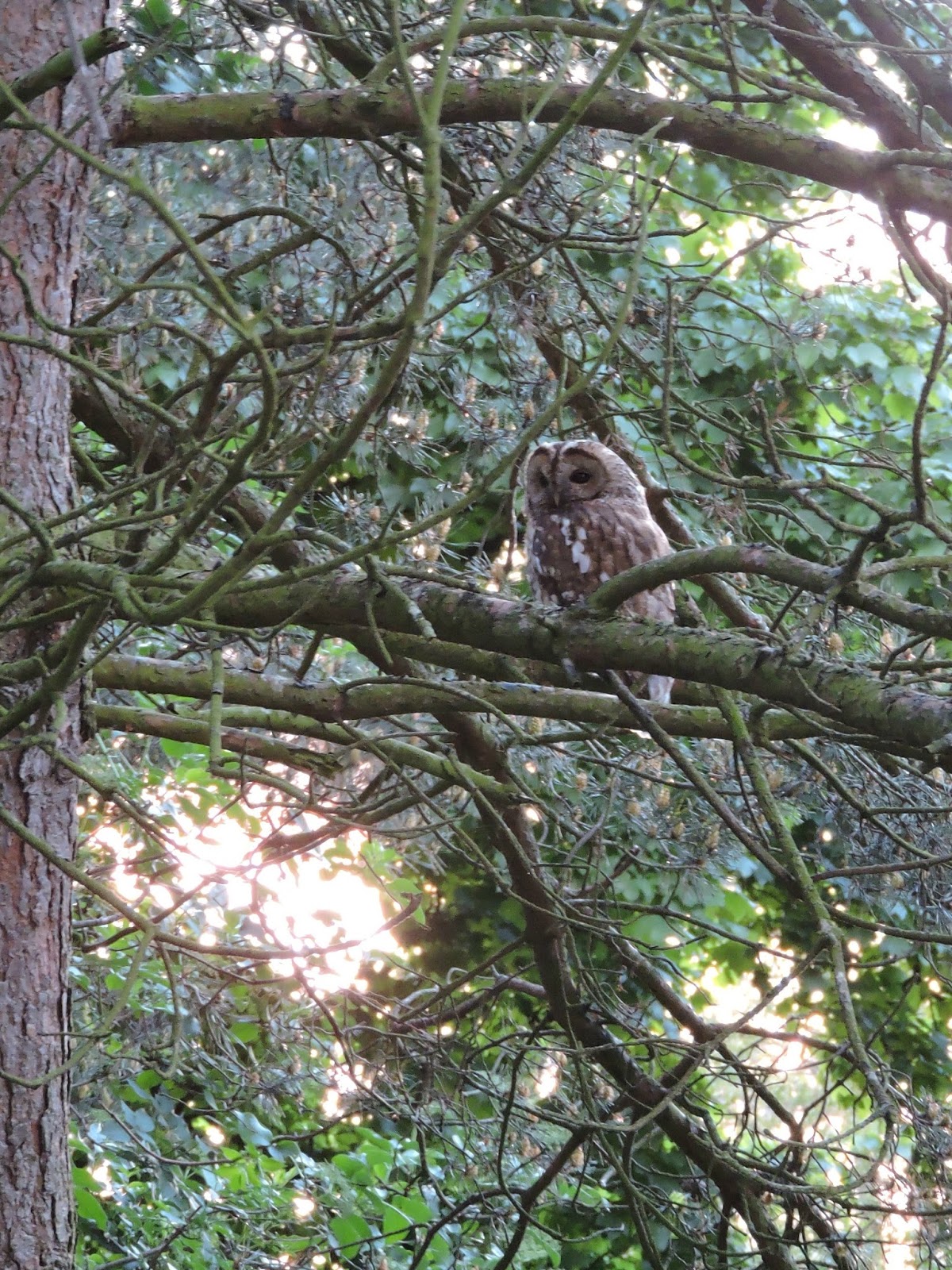
The tawny owl was perched in a tree right next to the path, looking straight at me. It was absolutely stunning. I occasionally hear tawnys at night; there are lots of mature trees near me and I live near Walmgate stray which provides good habitat, so that never really surprised me, but I hadn't at all expected to get a view like that. It's definitely the best I've ever seen a tawny owl.


While I was watching the owl (and trying to convince my camera that it didn't mind the low light too much) a couple stopped to watch it too. It was a real demonstration of how wildlife can bring people together- we would never otherwise have started talking. Personally, I think owls have a particularly powerful effect on us humans. I know I have been fascinated by them for as long as I can remember. Maybe it stems from seeing barn owls floating dreamlike over the Lincolnshire fields during long car journeys, or from a deep and abiding love for Jill Tomlinson's classic children's book "The Owl Who Was Afraid of the Dark," which I listened to on audio cassette so often when I was little I still know the first and last chapters almost word for word. It's one of the best books for young children I know of, and the beauty of it is explained perfectly in this piece.

I know now that owls aren't the super-intelligent birds which fiction and folklore paints them as; the corvids, which I also adore, fit that role far better. But when an owl looks you straight in the eyes, it feels like it's seeing inside you. That's a very special feeling indeed. I don't think I'll forget this wildlife encounter for a long time.

Wednesday 3rd June
I spent most of Wednesday in a training session for the Univeristy of York bloggers society (uni people, please come along next term, we'd love to see you!), so by the time I was finally free I was craving some fresh air. I decided to make the most of the weather being so gorgeous by getting off the bus a few stops early and walking through the most picturesque bits of campus.


It didn't disappoint. As well as the lake looking beautiful, as it does whenever the sun shines, the bees were out in force. It was lovely to see, especially after being reminded again how much they're struggling. Some wildflower meadow areas which I'd never found before were also full of insects, although the best picture I got (phone camera again) was from the flowerbeds near the lake. 
                                               

Thursday 4th June
Thursday was a fairly quiet day for me, so I decided to take a book, some tea and a croissant to a bench by the lake and sit in the sunshine. All of the birds were very active, but there was a repetitive high pitched squeaking which really caught my attention. It turned out that two coot chicks were responsible. 


I was stood close to the side of the lake when I heard a noise and the whole family came over the bank just in front of me. I don't know which of us was more surprised!


 The parents calmed down very quickly, and the chicks never seemed bothered at all by the fact I was there, so instead of trying to move and potentially startling them again, I stayed still while they started wandering around me. It was such a treat to see them so close up- how tolerant the wildlife here on campus is never ceases to surprise me.


The chicks were at that clumsy, intermediate stage, where they're big enough to wander a little way away from their parents, but still beg constantly for food (and look more than a little daft when they try to flap their wings). They're the oldest coot chicks I've seen so far this year, older than the family I have been following, which I'll hopefully be posting about soon. 

Friday 5th June
Friday was more waterfowl, but this time it was a moorhen family rather than a coot. I went out to look for the great crested grebe family I've been following (no photos of them just yet, I'll save that for another post) and on the way I found this little beauty.


There were two chicks along with an adult, and although both chicks were doing very well, this one found a floating can to use as a resting place. Although it's amusing at first, this really highlighted the pervasive role our litter plays in the lives of wildlife. The university campus is normally kept very clean, with lots of bins and regular litter picking, but with a lake in the middle there's only so much which can be done. And while this may be relatively non-threatening, the same certainly can't be said for all the rubbish out in the environment.

Saturday 6th June 


As you can see, my phone camera decided to have some fun while I was filming Fridays 30 days wild random act of wildness! The weather had turned, with a much cooler and windier day that anything we'd had so far in June. I love walks when it's windy, and the sound of the trees is like the sea in Autumn,  It's such an exhilarating feeling. I didn't see much wildlife, most of the animals were probably sheltering, but there was a blackbird braving the weather. Blackbird song is something else which I find incredibly powerful. It brings to mind long summer holidays and evening walks with my family or my friends, or sitting out in the garden as the dusk comes in around me.

Sunday 7th June
For Sunday, I took inspiration from the Wildlife Trusts' 30 days wild booklet and decided to "feel the cool grass beneath my feet," so while I was in York, I picked up some food, went to museum gardens and had a picnic barefoot. It's something which is so lovely to do, but so easy to forget about. Again it's something which reminds me of summers spent playing in the garden as a child. That's one of the things I'm enjoying the most about doing 30 days wild. There's a brilliant line on the website which sums it up perfectly for me: "After all, nature makes us all feel young at heart, so why should kids have all the fun?" My first year at university is drawing to an end, and I've absolutely loved it, but every so often it strikes me just how much has changed this past year. So much has happened, and it's sometimes a lot to process. So sometimes slowing down and taking time out of my day is exactly what I need.

Wednesday, 3 June 2015

Goslings and springtime

Hello! It's been a while since I posted on here; I've had a busy few weeks with exams and a holiday in North Yorkshire (more on that in another post). Excitingly, I was also Blogger of the Month in the May edition of the BBC Discover Wildlife Magazine, which printed extracts from my post on the solar eclipse. This was incredible (and very unexpected considering I've only been blogging since February), so a big thank you to everyone at the magazine! I've been posting my blog updates on their local patch reporter forum since I started writing. There are lots of absolutely fantastic wildlife and nature bloggers on there, as well as information on how to get involved, so it's well worth having a look!

We have greylag, Canada and snow geese on campus, as well as the barnacle geese in this picture.
Unfortunately, the weeks I've not had much time to post blogs have coincided with the weeks with lots going on for wildlife on campus. The lake has been filled with nesting birds all term (I've got a post on a family of great crested grebes and a coot family coming up soon) but over the past few weeks it's really come to life. The University of York is famous for its geese (when I told people where I was going to uni, the standard response was "oh, I had a friend there. Visited once. Geese everywhere.") so unsurprisingly the campus has been absolutely covered in goslings. It's been absolutely brilliant.

A greylag gosling in the daisies outside my halls
At this point I probably need to say that you should always be careful with geese. The adults can be aggressive at the best of times, and will be even more so if protecting a nest or goslings. So please, don't get too close, don't startle them and keep an eye out for any obviously threatening body language. Otherwise, you might end up getting chased down a path by some, like a friend and I did! I've forgiven them though. I mean, look at them.


Geese are great because, aside from the goslings basically being little balls of fluff, guaranteed to cheer you up on the way to an exam, they are incredibly easy to see. Like ducks, they are pretty much everywhere, not just on my campus, but out in the wider world too. This is, in my opinion, fantastic- wildlife is on everyone's doorsteps in one form or another, and no species is less worthwhile or interesting for being common.


The geese were also really interesting to watch from a behaviour perspective. As the goslings got older, the number of adults with them got less. I was curious about this, so decided to do some reading. Having a larger group of young in a crèche is well recorded in a range of waterfowl species, including geese, although the evolutionary reasons for this are not always clear- if you'd like to know more technical details, this paper is great, although quite long. 

A creche of older goslings
This post has focused on the geese, but I've got lots more on other campus wildlife and the things I got up to on holiday coming up soon. For now, I hope you enjoyed the goslings!

 Have you had goslings, or any other spring babies, where you are? I'd love to hear your stories in the comments!

Alexandra xx


References:
The paper I used for reading about crèche behaviour in geese is here:

Thursday, 30 April 2015

In defence of gardening

I seemed to spend a lot of my Easter holidays outside in the garden. When I was little I adored gardening, but exams have got in the way over the last few years. So getting some time in the fresh air was a real treat.


I know gardening isn't exactly a typical part of the student lifestyle, but it's seriously underrated. We were clearing out all the dead stems which had been left over winter because ladybirds and other insects hibernate in them. After a morning of biochemistry revision an afternoon pruning was much needed stress release. It was also great exercise, as I found out when I couldn't move my shoulder the next day!

My cat enjoys helping with the gardening too!

Spring is one of my favourite times of year, and one of the reasons are the wildflowers which start to really come into their own. Everything goes from grey, brown and dull green to the bright colours of spring flowers and everything becomes a new, more vivid, green. Over the month of the Easter holidays our garden was full of sweet violets. They're tiny little flowers, but so beautiful and delicate.


Primroses are also one of my absolute favourites. We have the native yellow ones, as well as the brightly coloured cultivars. In fact, primroses are slowly colonising the lawn of our front garden. They're far more interesting than grass in my opinion! As I was photographing this one I saw a tiny insect on it. Insects really aren't something I know much about, so if anyone has any ideas what it could be I'd be very grateful.


This photo sums up what I love so much about gardening. You get to spend time outside and get exercise with something to show for your effort, and after a while you start to tune in to the natural world. You begin to see small things which you'd never normally notice, but which are incredible all the same. Our lives now are so busy and for the most part so detached from the world around us that just stopping to breathe. and look, and take everything in can be so valuable. 

When we take the time to look around, the smallest things can be the most beautiful.

So, that was my attempt to brainwashing you into thinking that gardening isn't just for people with far too much time on their hands.You might not agree, and I wouldn't blame you for it. But I enjoy it all the same.

Alexandra xx